
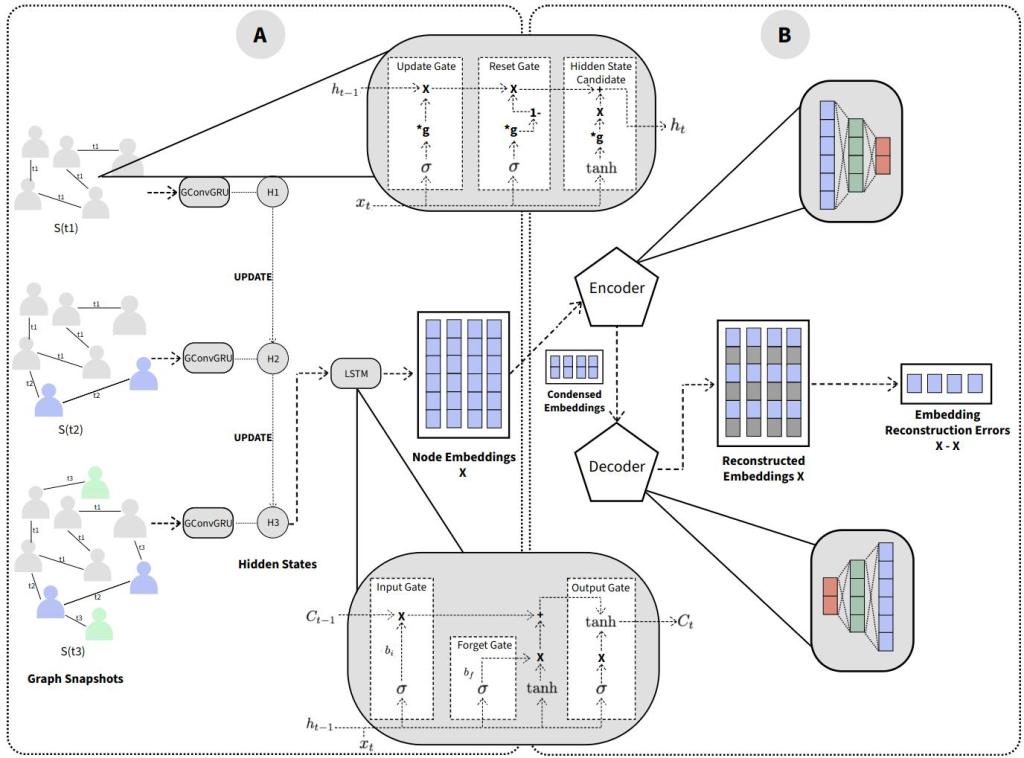
Dynamic graph anomaly detection is increasingly pertinent due to the evolving nature of data across various domains. This field faces significant challenges, including the scarcity of labeled data for supervised anomaly detection and the complexity introduced by the temporal variability of nodes and edges across multiple graph snapshots. While existing literature has explored temporal and structural tracking, these approaches often fall short in capturing longer-term dependencies, which are crucial for effective anomaly detection. In this paper, we introduce a Temporal STRUCTural Graph Anomaly Detection (T-StructGAD) mechanism, which represents a novel unsupervised framework for detecting anomalous nodes in dynamic graphs by capturing long-term dependencies across the graph. Our approach employs a hybrid model that integrates structural and temporal dependencies through the use of Graph Convolutional Gated Recurrent Units (GConvGRUs) and Long Short-Term Memory networks (LSTMs) to generate node embeddings. These embeddings are subsequently utilized to identify anomalies via AutoEncoder reconstruction error metrics. We validate our framework through extensive experiments on four diverse real-world datasets, each containing natural outliers. The results demonstrate that our method outperforms 12 representative graph anomaly detection algorithms, thereby confirming its efficacy in identifying anomalies in dynamic graph environments.
Deep Temporal & Structural Embeddings for Unsupervised Anomaly Detection in Dynamic Graphs

 Kurban Intelligence Lab